The Car That Drifts Itself: One Year of BS Drift
July 15, 2026 · #drift #ai #sporttech
Contents
A figure-eight with no one behind the wheel
One year ago, an AI drift car was just an idea. In summer 2026 a real BMW completed a fully autonomous figure-eight drift — no human behind the wheel, no remote control. A neural network controlled steering, throttle and brakes in real time.
The figure-eight is not a simple turn: it combines every core element of competitive drifting — stance, transition and arc — at once. The AI reads the car’s position, speed and angle 30 times per second. It doesn’t just react; it acts.
How the AI learns
The training pipeline runs on three sources at once:
- A professional pilot drives the car on a real track while the system records everything — steering input, speed, exact position.
- A virtual simulator runs thousands of laps to train the model beyond what physical testing allows.
- Reinforcement learning ties it together: instead of following fixed instructions, the system improves with every lap.
The biometric suit
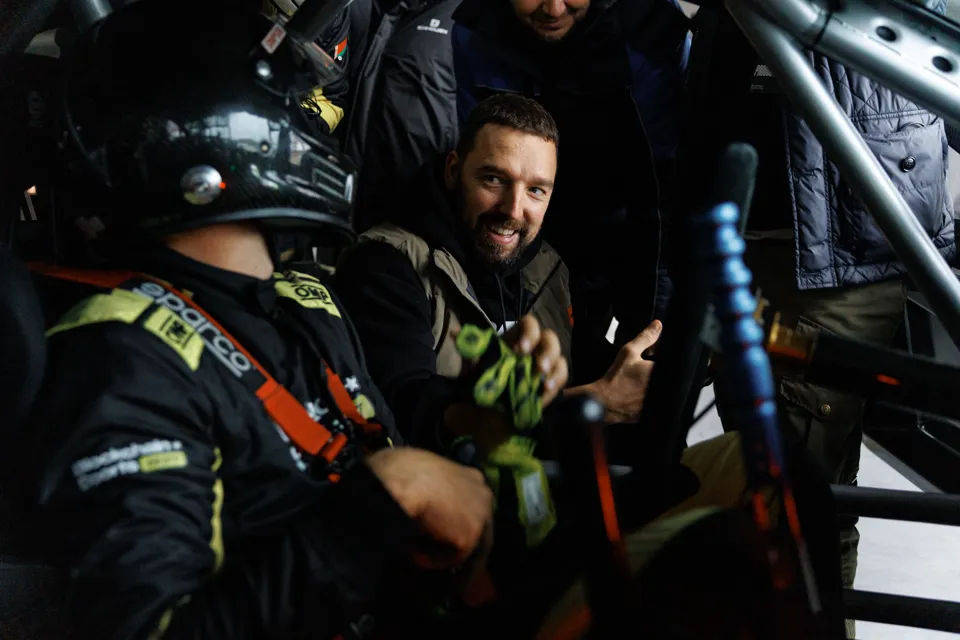
The pilots wear a biometric suit embedded with sensors that capture micro-movements, muscle reactions and physiological responses in real time — from heart-rate spikes mid-tandem to steering precision at 150 km/h. It is not just motorsport gear: it is a data pipeline feeding the world’s first pure reinforcement-learning drift car.
Why it matters
The Drift programme is the loudest demo of the ecosystem’s hardware division — the same XR Lab that builds haptic suits for XR football, medical robotics and motorsport simulators. One of the project’s promos, starring actor Til Schweiger, passed 4 million views on YouTube, with central streets of Belarus’s largest cities shut down for the shoot.
A-list names don’t show up for concepts. They show up for working products.